Eugène Delacroix (1798-1863), romantic painter
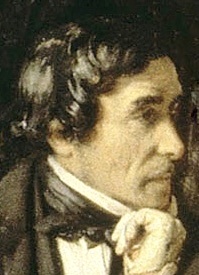
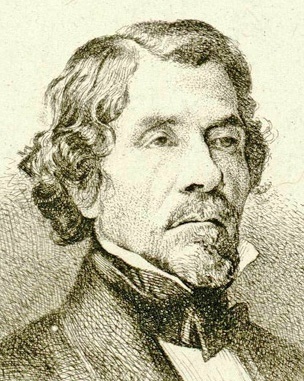
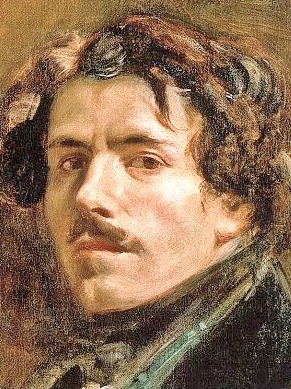
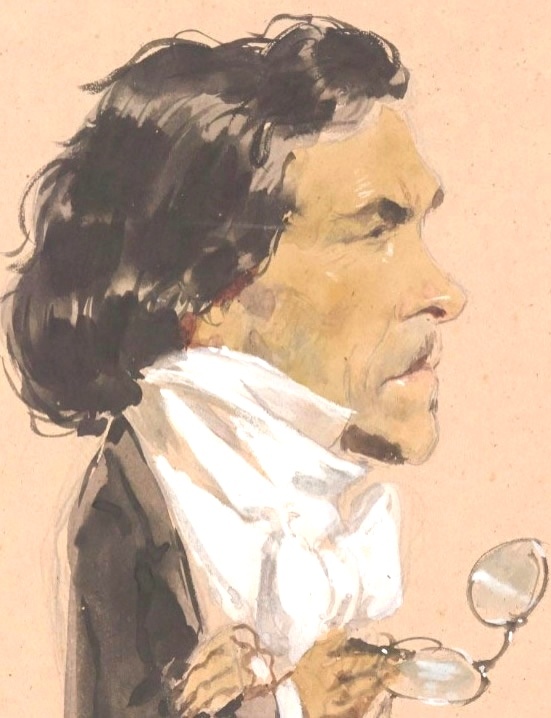
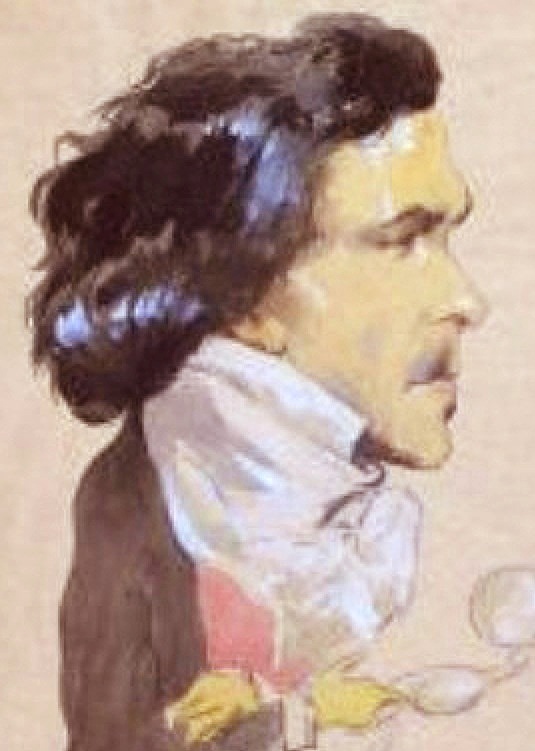
1stimage: Soirée; 2nd: Gravure by Gigoux (1864); 3rd: Auto portrait (1837); 4th: caricature by Eugène Giraud drawn mid 1850 at Nieuwerkerke's soirée; 5th: caricature drawn by Giraud in 1856.
Eugène Delacroix was regarded as one of France’s greatest Romantic painters, alongside Jean Ingres39 and Ary Scheffer41a. A regular guest at de Nieuwerkerke’s vendredi-soirées from June 1850 until his death in 1863, he was the only figure to be caricatured twice by Giraud11. In the second caricature, Giraud depicted Delacroix wearing the cravate rouge of a Commander of the Legion of Honor, a distinction he received on November 14, 1855.
Born in April 1798, Delacroix’s parentage has long been a subject of speculation. At the probable time of his conception, his father suffered from a large 14 kg tumor on one of his testicles, making procreation seemingly impossible. The tumor was removed in late September 1797. Some theories suggest Delacroix was the son of the influential politician Talleyrand; however, given his striking resemblance to his brother Charles, his father—formerly a French minister in the Batavian Republic—may have remained physically capable of fatherhood.
Delacroix arrived in Paris in 1815 to study under Guérin, where he befriended painters Henri and Ary Scheffer41a. The following year, he was admitted to the École des Beaux-Arts and soon developed an admiration for the works of David. Like Scheffer, his early paintings focused on classical themes inspired by Dante, before transitioning to revolutionary subjects in 1830.
In early 1832, Delacroix embarked on a six-month journey to Morocco with the ambassador Count de Mornay, which profoundly influenced his artistic direction (Mornay intitially thought of Eugène Isabey75, but he had already been there, and refused). This expedition provided inspiration for a series of paintings and watercolors depicting North African society, rich in vibrant colors and dynamic compositions. His works frequently portrayed violent action and intense emotion.
In 1831, the Liège-born art enthusiast —and future Louvre conservator— Frédéric Villot72 acquired Delacroix’s Murder of the Bishop of Liège (1829). This marked the beginning of an intimate friendship between the two men. Villot went on to collect many of Delacroix’s works, and in 1832 the painter produced a portrait of Villot. Although Delacroix’s journals contain a gap between 1832 and 1840, his surviving sketches attest to the mutual affection between him and Villot’s wife, Pauline. Delacroix’s notebooks include more than one hundred references to Villot, far exceeding those devoted to any other friend, and record the many pleasurable evenings and dinners he shared in the company of Villot and/or his wife.
While drawing a portrait of George Sand in 1842, Delacroix met Frédéric Chopin, with whom he formed a lasting friendship. As an extroverted artist, Delacroix —alongside the more reserved Scheffer— was among the few painters given the rare privilege of portraying the notoriously introverted composer.
Writer Charles Baudelaire considered Delacroix "decisively the most original painter" of that era, although his judgement may have been biased by the fact that both of them, with others like Alexandre Dumas and Théophile Gautier, were the core members of the Parisian "Club of the Hashish-Eaters."
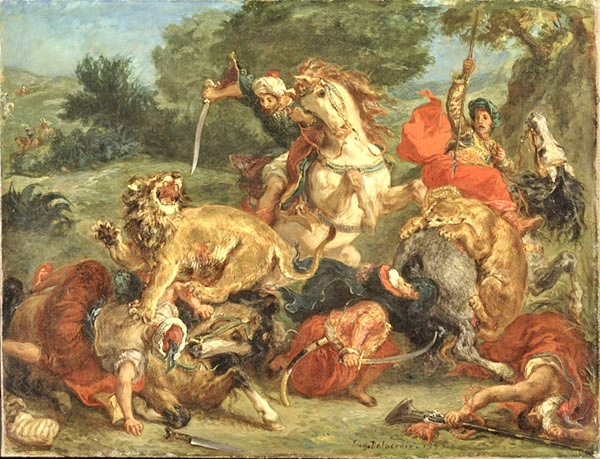
At the request of de Nieuwerkerke, Delacroix presented a retrospective at the 1855 Salon, showcasing thirty-five works. Among them was his 1855 composition (he made several versions) The Lion Hunt, likely inspired by the vendredi-soirée lecture that year by lion killer Captain Gérard32