The History of Une Soirée au Louvre
Click images above to access other main pages. Click Une Soirée or outside this page for the interactive image.
Part Two: Giraud’s caricatures and Biard’s painting
From the outset, de Nieuwerkerke sought not only to publicize his vendredi-soirées through the press but also to create a lasting visual record of the guests and the singular atmosphere of these gatherings. The precedent for such an undertaking was well established: in the 1840s, François Heim28b had started a celebrated series of portraits of members of the Académie. It is plausible that de Nieuwerkerke initially approached Heim with a similar commission.
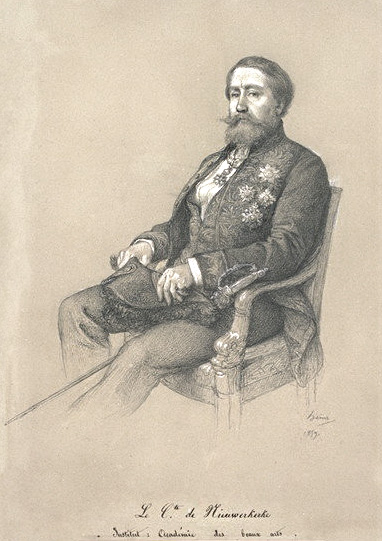
Yet Heim’s success at the Salon of 1850 had generated a flood of new work, making him unavailable. De Nieuwerkerke therefore turned to Eugène Giraud11 — Prix de Rome laureate, close friend of Princess Mathilde, and one of her drawing instructors — to assist in documenting the soirées.
Giraud produced his caricatures not during the soirées themselves but at the informal “après-soirée” gatherings held in de Viel-Castel’s atelier at the Louvre. There, a select circle of guests would retire after eleven o’clock to drink tea and smoke cigars (then a state monopoly). In this intimate setting, Giraud, either at de Nieuwerkerke’s direction or on his own initiative, would spend roughly two hours producing a watercolor caricature.
Art collector Henri Didier (owning paintings by Decamp, Rembrandt, Rubens, Tintoretto) recalls in Revue des Beaux-Arts, 1858, his visits since 1850:
“ When, around eleven o'clock, the crowd began to disperse, I remember a certain look that was given to us, sometimes accompanied by a light tap on the shoulder, as if to say: the evening isn't over for you. Then we would slip out of the main drawing room, like schoolboys playing truant; we would slide down a small spiral staircase, tiptoe into the study, and there a more intimate evening would begin. During those few hours between night and day, more gaiety and enthusiasm were displayed than at any official gathering. A spirit of good camaraderie and charming informality reigned, exemplified by the host himself, retaining from his superiority only that of intelligence and talent. “
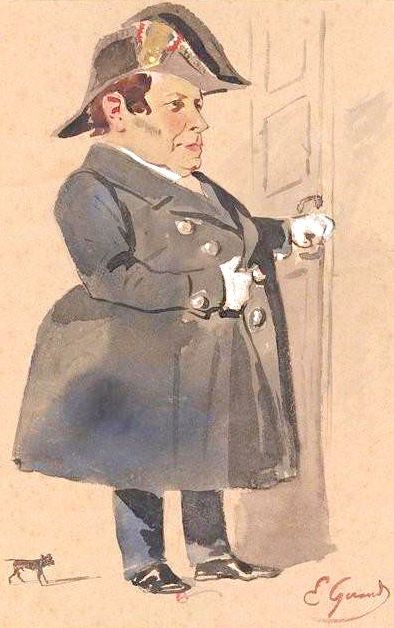
The earliest of Giraud’s dated caricatures is that of the conservator Eudore Soulié34, executed in early 1851. During that year he produced approximately a dozen works, one per week.
Although fewer caricatures are dated in subsequent years, the surviving chronology makes clear that Giraud habitually created them during the vendredi-soirées of the first months of each year.
Over the course of two decades he produced more than two hundred caricatures — always humorous, never malicious — the last dated 1 April 1870 (Comte de Beaumont).
Approximately 170 of these survive today in the collections of the Bibliothèque nationale de France. During my research I was able to provide the BnF with additional identifications, including that of the Louvre concierge Hénault, whose tiny dog regularly played with the dog of Tito Franceschini04b, secretary to Napoleon III.
The commissioning of Une Soirée au Louvre
Alongside Giraud’s caricatures, de Nieuwerkerke conceived a more ambitious project: a monumental painting that would immortalize his weekly gatherings.
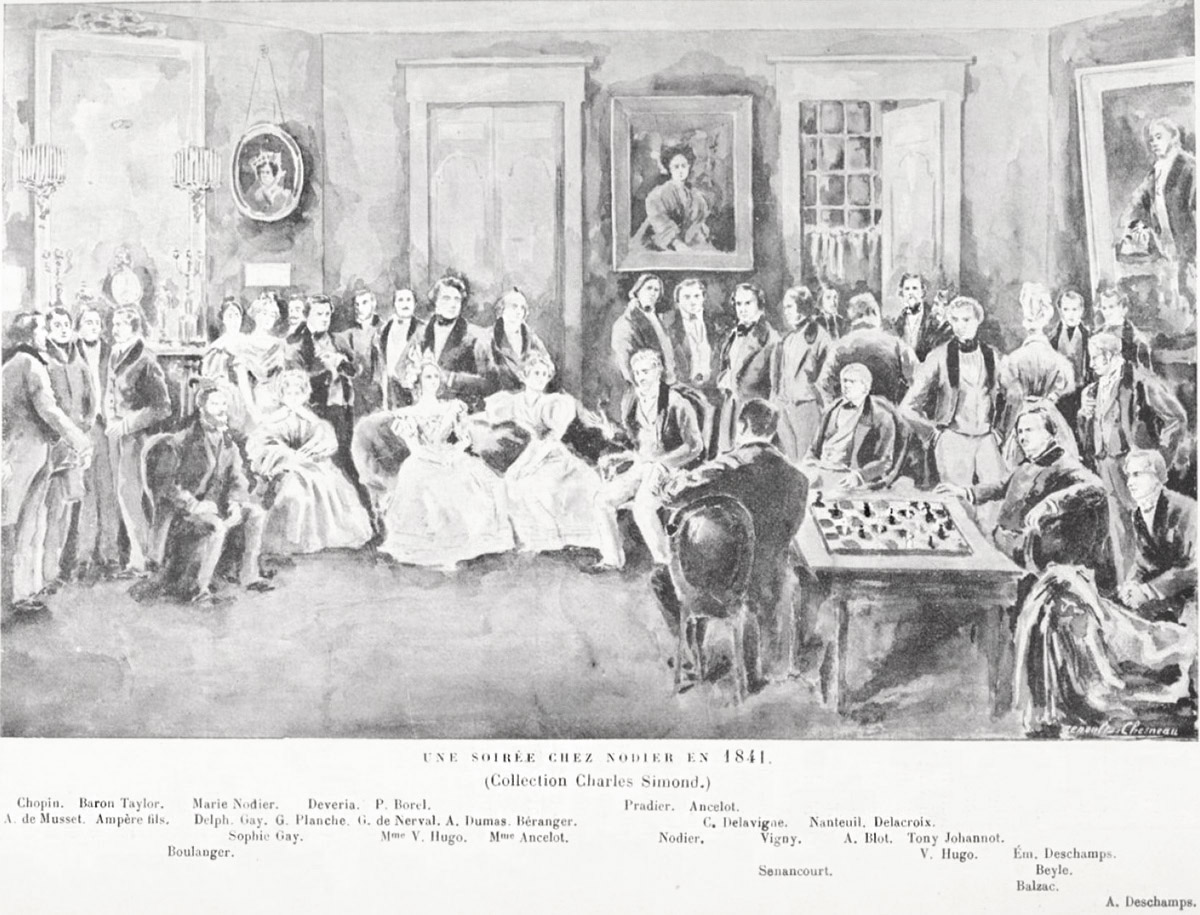
Watercolor depictions of literary and artistic salons already existed — for example, the 1841 representation of Charles Nodier’s soirées, featuring Chopin, Delacroix, Musset, and Pradier — but de Nieuwerkerke aimed for something on a far grander scale, in the manner of Heim’s large multi-figure compositions.
He may have discussed the idea with Heim around the time of the 1850 Salon, but soon realized that neither Heim’s schedule nor his artistic independence would allow such a commission.
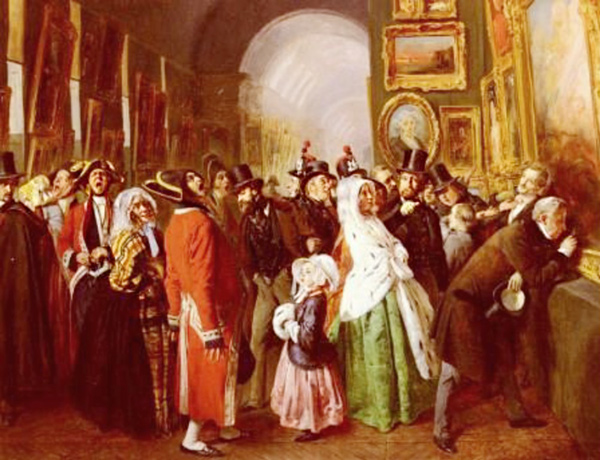
For several reasons, the task ultimately fell to François Biard. Although largely self-taught and not a Prix de Rome laureate, Biard was known for his exotic Arctic and African scenes and had experience depicting large crowds, notably in his 1844 painting of Queen Victoria’s departure, his humorous 1847 Louvre scene, Four O’Clock at the Salon, and its lesser known pendant work Closing Time (1847). These works may have convinced de Nieuwerkerke that Biard could serve as a viable alternative to Heim.
Note: In these paintings, Biard charmingly illustrates that it was common in these days to lean into, squint at, or even touch the museum canvases.
Biard’s personal circumstances may also have played a role. His marital scandal of 1845 — discovering his wife Léonie d’Aunet in flagrant adultery with Victor Hugo — had resulted in public humiliation and extensive press coverage (see profile Biard36). De Viel-Castel43 noted in his journal in July 1851 that Biard, perhaps out of sympathy, had received several state commissions.
Unlike Heim, who would not have tolerated restrictions on his artistic autonomy, Biard accepted de Nieuwerkerke’s requirement that he retain full control over the selection of sitters. Rather than allowing the painter to populate the canvas with figures of his choosing, as in Heim’s Le Roi distribuant des prix au Salon de 1824, de Nieuwerkerke intended to determine the entire cast from among the thousands of aristocratic guests who attended his soirées.
The painting was intended for completion before the Salon of 1854. Although no written commission has yet been located, it is likely that Biard received a verbal agreement in late 1851 and began work in early 1852.
Progress on Une Soirée
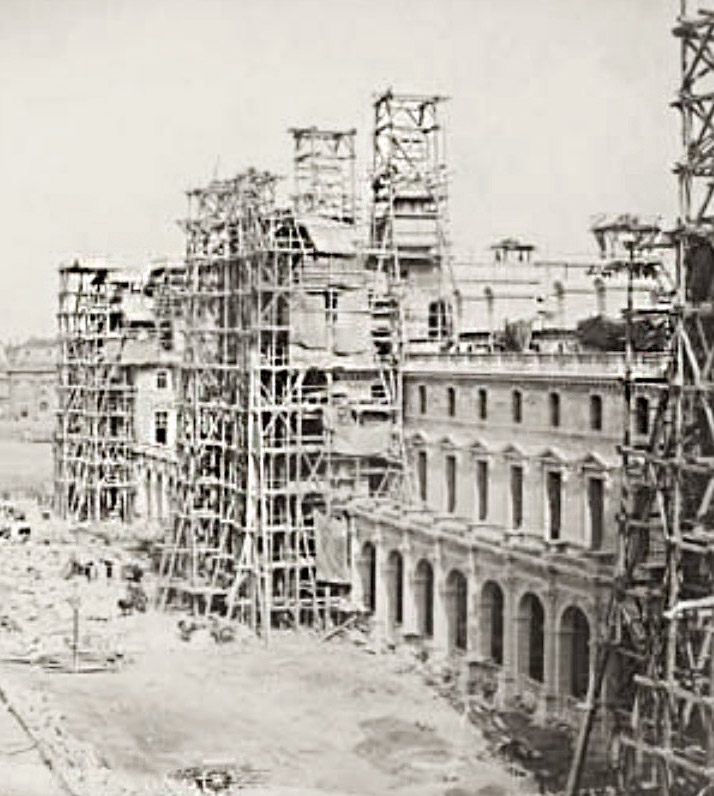
of the Louvre (c.1854)
Biard first devoted considerable time to sketching the interior of de Nieuwerkerke’s salon — its tapestries, chandelier, and architectural details — which he then transferred to canvas in his studio at 8 Place Vendôme.
None of the many press publications mention that, unlike Giraud, this “vaudeville artist” ever was invited to, or otherwise attended, an actual vendredi-soirée.
Biard’s emphasis on the background was shaped by the decision of March 1852 to undertake a five-year restructuring of the Louvre beginning in July. This forced de Nieuwerkerke to relocate both his apartments and the soirées to the second floor.
From March 1854, guests entered via the Henri IV staircase near the Pavillon de l’Horloge rather than the Grand Escalier, which was demolished and replaced by the present Escalier Daru.
Une Soirée thus provides the only surviving visual record of the original salon.
During this phase, de Nieuwerkerke likely compiled a list of preferred sitters. The earliest names would have included his conservators (de Viel-Castel, Soulié), prominent guests from the first soirées (Ingres39, de Musset73, de Morny48, Viollet-le-Duc40a, Baroche61), his conductor Pasdeloup12, and performers such as Roger04a and Ponchard25.
Rachel Félix’s81 spectacular appearances in 1850 and early 1852 almost certainly inspired the idea of placing her at the center of the composition. Over time, de Nieuwerkerke appears to have added more figures on an ad hoc basis, including Captain Gérard32, the “lion-killer,” and the diplomat Vély-Pacha13 in early 1854, eventually assembling a list that may have exceeded one hundred names.
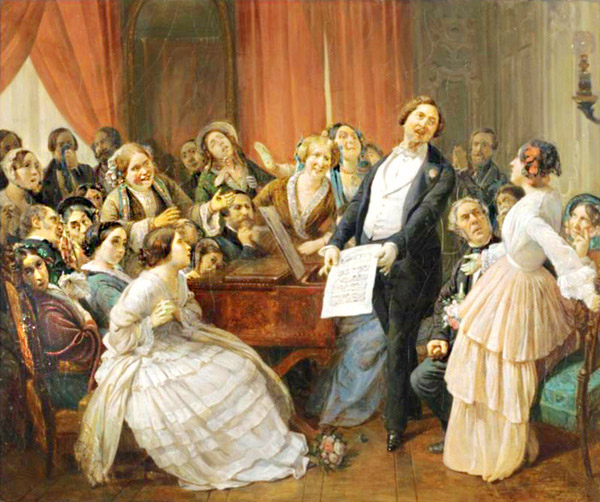
Biard’s preliminary sketches of sitters willing to pose in his studio likely began in early 1852. These will have included the sculptor Pradier03, who died in June of that year (unless Biard relied on an engraving).
Progress remained slow, in part because Biard was preparing works for the Salon of 1853, including Gulliver in a Cornfield (now untraced) and Triomphe d’un Ténor (auctioned at Sotheby’s in 2024).
Critic and caricaturist Félix Nadar mocked the exaggerated, “hysterical” female poses in the latter, comparing it to Biard's quality work "Mort de Du Couëdic recevant les adieux de son equipage (1840)," at Musée de Luxembourg.
He writes:
“M. Biard. A dried-out brain.
When M. Biard shakes his head, it must go: clack! clack! clack!
And yet, if you look back, remember what M. Biard once left to the Luxembourg!
That’s where you end up when you take the easy way out — concession after concession to the bourgeois — until you arrive at delirium tremens… which is exactly where you are.”
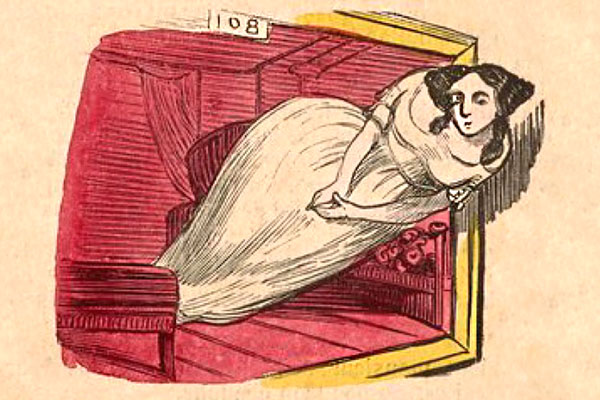
Triomphe d'un Tenor (Salon 1853)
Such criticism created an unfavorable climate for Une Soirée.
By the opening of the 1853 Salon, the project had reached a point of no return, leaving de Nieuwerkerke with no alternative but to continue.
Aside from the background, little had been completed. Few guests were willing to pose in Biard’s cramped studio.
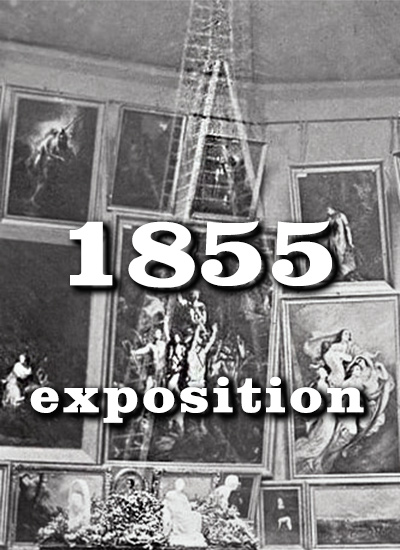
Biard must therefore felt relieved when, on 22 June 1853, it was announced that the Salon of 1854 would be cancelled in favor of the Exposition Universelle and its accompanying art exhibition, scheduled for May 1855.
As Biard worked to translate the vendredi-soirées onto canvas, unexpected pressures forced de Nieuwerkerke to rethink the composition — leading to the dramatic 1854 revision.
>>> Part Three: The 1854 revision