The History of Une Soirée au Louvre
Click images above to access other main pages. Click Une Soirée or outside this page for the interactive image.
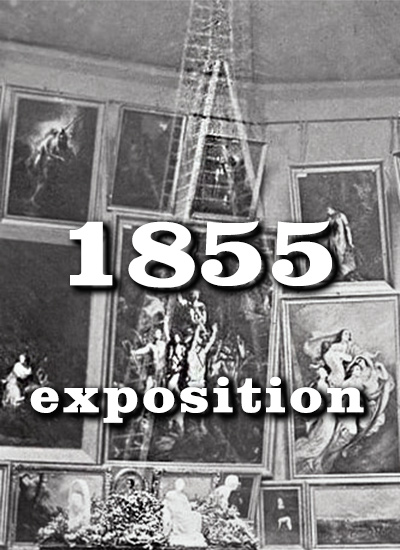
Part Four: The Universal Exposition of 1855
Despite its late entry, Une Soirée made it into the official catalogue (Explication des Ouvrages) of the Salon of 1855, together with nine other Biard works.
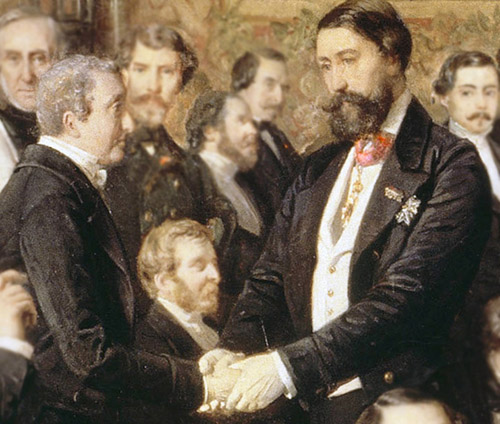
De Nieuwerkerke16, appointed president of the jury on 20 January and thereby empowered to accept or reject works at will, must have ensured that his personal, self-promotional canvas was included. He could also rely on the goodwill of many jury members who appeared in the painting itself: Chaix d’Est-Ange06, Desnoyers35, Flandrin79, Heim28b, Müller18, Reiset65, Troyon40b, Vernet31, Villot72, and Duret59, with additional voting authority held by the executive members Fould17, de Morny48, Ingres39, Delacroix10, and de Mercey22.
If we take into account the jury members of the sculpture and architecture sections, the list expands to a total of twenty-five depicted men involved in the acceptance process.
Before the Salon opened, Une Soirée became the focus of intense administrative activity.
On 11 May 1855, four days before the public inauguration, Achille Fould, Minister of State and Minister of the Emperor’s Household, issued a decree purchasing the painting directly for Napoleon III. Officially titled Le Salon du Louvre, it was valued at 8,000 francs and charged to the special fund for artistic encouragement administered by the Emperor’s Household. This mechanism allowed Fould and de Nieuwerkerke to draw rapidly from this 240,000-franc fund.
By this time, the catalogue had gone to press, using the title Le salon de M. le comte de Nieuwerkerke, with administrative number 2,561. This number also appears in the archival trail carefully reconstructed by Louvre conservator Nicole Villa (1922–2008), who located the acquisition order, the receipt signed by the Conservator of Paintings and countersigned by de Nieuwerkerke, and the Louvre inventory entry registering the work as no. 1272.
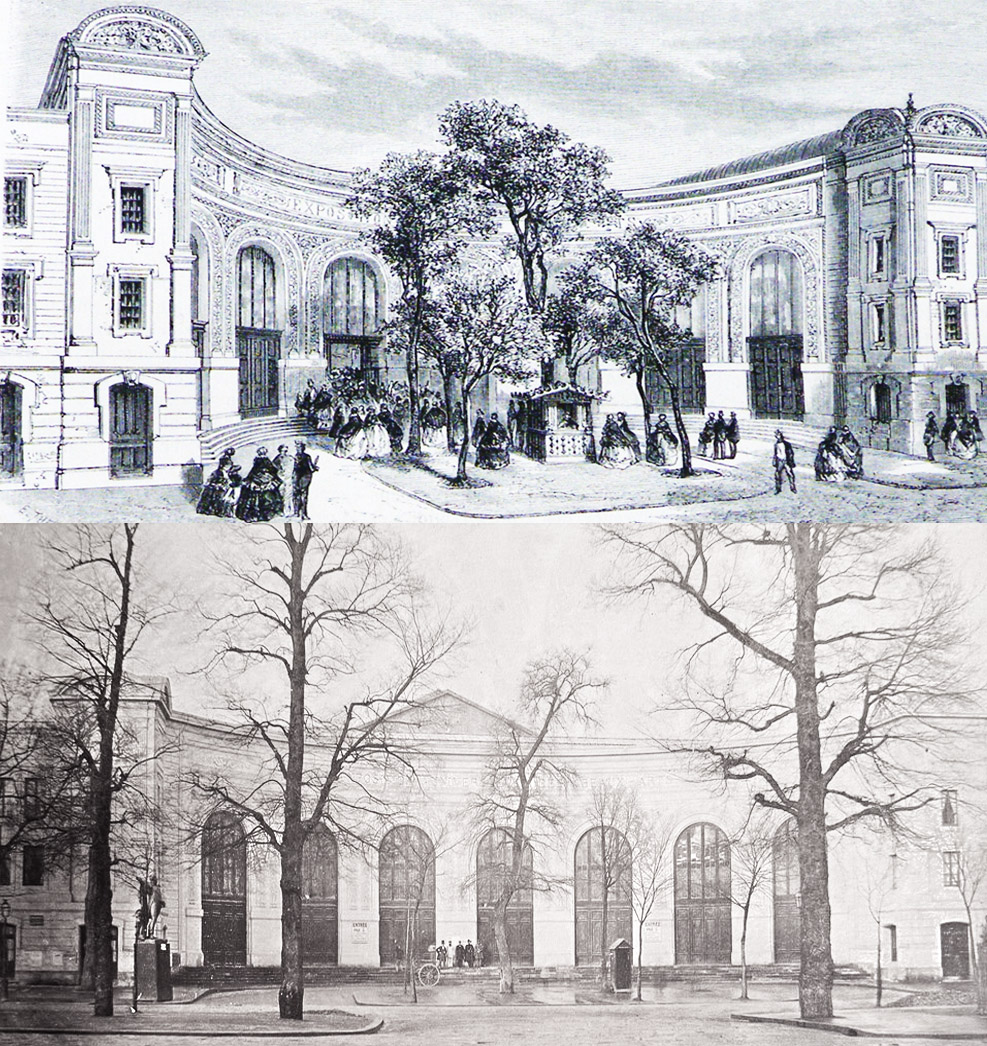
The Salon of 1855 formed an integral part of the Universal Exposition, inaugurated on 15 May by the Emperor, the Empress, and Princess Mathilde. Of the Exposition’s five million visitors, approximately 900,000 entered the Palais des Beaux-Arts on the Avenue Montaigne. This temporary structure, a plaster-coated wooden building erected specifically for the exhibition, was dismantled shortly thereafter. More than 5,000 works were displayed, with France represented by 692 painters and 1,867 paintings. Admission was one franc on weekdays and twenty centimes on Sundays.
Note: The 1855 Universal Exposition appointed Disdéri as official photographer. Up to that time, engravings were the only medium available for presentation of art works. Photography added a new dimension. The image above shows an engraving of the entrance of the Salon, and Disdéri's photograph. The first provides an attractive artistic perspective, with detailed facade and a kiosk, while the photograph (probably taken towards the end of 1855) provides a much less grand perspective.
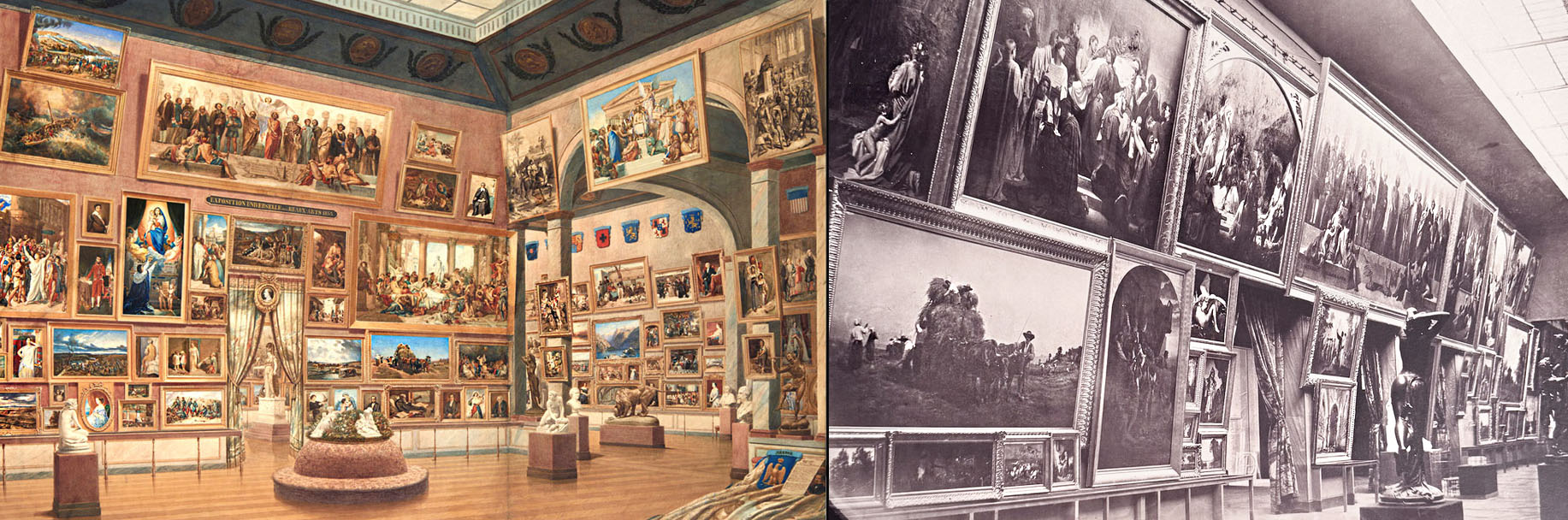
but Fournier's organisation and size of the art works differs substantially from the actual exposition (click to enlarge).
Critical attention quickly coalesced around several works.
Rosa Bonheur’s La Fenaison en Auvergne, exhibited in the Salon Carré, was widely hailed as the sensation of the Salon. Amaury Duval44a received favorable reviews for his portrait of Rachel81. Heim, too, was celebrated: his monumental Charles X Distributing the Prizes of the Exhibition was displayed in the same gallery. Yet not all established masters were praised. Delacroix was dismissed by some critics as “decadent,” while Ingres was reproached for “cold academicism.”
In contrast to these figures, Biard — already regarded more as a genre humorist than a serious history painter — received no positive reviews for Une Soirée. Critics acknowledged the curiosity of seeing so many aristocratic figures gathered in a single composition, but little more.
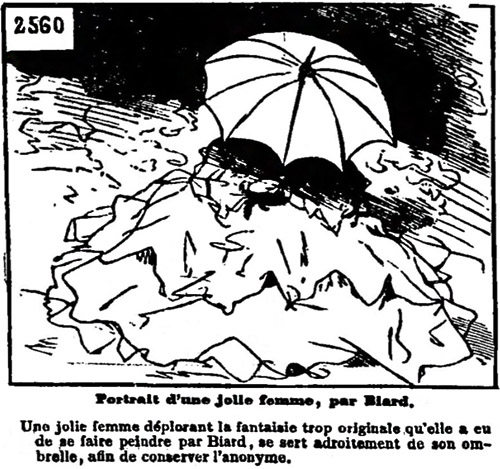
The only humorous illustration in the popular press referred to the Portrait de Mme …., Biard’s work with number 2560 (the one that predecessed Une Soirée). Caricaturist Bertall writes in the "Journal of laughter":
“A lovely lady, lamenting the overly original idea she had of being painted by Biard, deftly deploys her parasol to keep her identity hidden.”
Intermezzo: Disdéri photographs
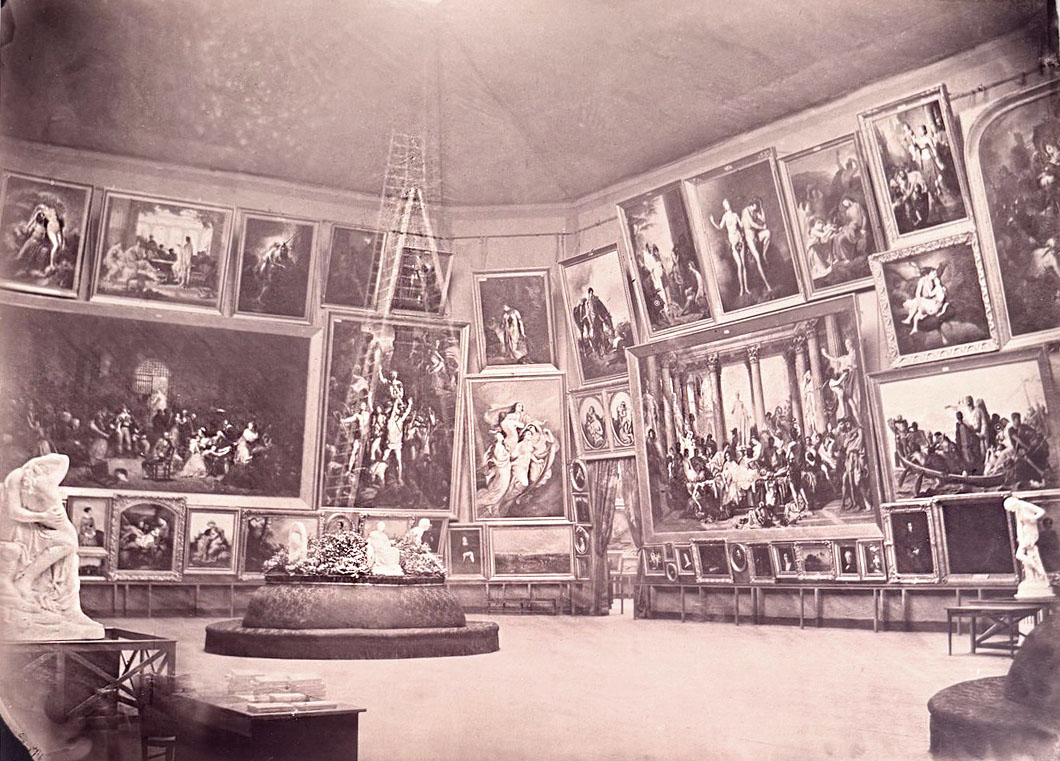
Before converging on the press reception of Une Soirée, I’d like to draw your attention to a fascinating image taken by Disdéri, the photographer of the 1855 universal exposition.
It shows the Salon Carré during the 1855 exposition. A copy of his album can be found at this gallery website.
To the right of the doorway in the background stands the immense canvas L’Orgie Romaine by Thomas Couture (472 × 772 cm). On the left we see the Appeal of the Last Victims of the Terror by Müller, with monumental dimensions of 505 × 890 cm.
Between these two paintings, one can spot the ghostly reflection of a very tall ladder — likely the result of a double exposure or a reflection from a glass panel in front of the camera. This image, together with the one of the front entrance, suggests that Disdéri took his photographs at the end of the exposition.
Another striking detail is the large painting in the center (386 × 256 cm), depicting five floating nymphs by Barbizon painter Narcisse Virgilio Díaz. This canvas would later become part of Hitler’s art collection for his planned (but unrealized) Führermuseum in Linz.
Press Reviews of 1855
Édouard Thierry, writing in the Revue des Beaux-Arts, observed:
“Biard’s painting (‘The Salon of M. de Nieuwerkerke’) was briefly placed alongside that of M. Heim, ‘King Charles X Distributing the Prizes of the Exhibition’; but the comparison was not to its advantage. Biard’s painting needs to be completed, clarified, freed from its dubious lighting and vague resemblances. All this can be done, provided everyone cooperates, and that those who posed for a moment without sitting down are willing to sit down for a moment to pose.”
Ernest Gebauer, in his overview of the Exposition, was even more severe:
“Even if we were to appear overly harsh, we declare that we feel no sympathy whatsoever for the Salon of Count de Nieuwerkerke. The primary flaw of this work is that it depicts, in this undeniably artistic salon, as many generals and members of parliament as artists.
The execution is weak: nothing is finished, nothing is deliberate, nothing is precise. M. Biard must have asked himself more than once, while looking at his work: ‘Are these portraits or caricatures I’m creating?’ If they are portraits, they lack interest. If they are caricatures, they are not amusing.”
Edmond About wrote, among many other strong judgements, in his review:
“M. Horace Vernet lacks style, but he is not vulgar. His talent lies somewhere between genius and triviality. Go down one level; go down several, go down again: you will arrive at M. Biard.”
Maxime Du Camp, in Les Beaux-Arts à l’Exposition universelle de 1855, added:
“M. Biard tried to imitate M. Heim by painting a similar work under the title: ‘The Salon of Count de Nieuwerkerke’. These two canvases must be seen one after the other, and one will be convinced that one will always live and that the other never has. M. Biard played with art; unable to understand its grave and serious aspects, he wanted to reduce it to a grotesque role only to elicit laughter from fools; he has so many caricatures that now, even when he wants to execute a serious work, he can only paint caricatures. He is punished in the very way he sinned, and that serves him right.”
Claude Vignon, in his extensive review of the beaux-arts section, delivered the most devastating critique, and praises the jury members for their courage to accept it:
“Alas! alas! alas! What has become of M. Biard’s painting, and where is it going? […] Let us not speak of the polar bears brought back from the icy seas, nor of Gulliver in the land of the Giants; but what is this sooty, charcoal-like painting of sinister faces that calls itself the ‘Salon of the Comte de Nieuwerkerke!’ Truly, one would be wrong to say that the members of the jury take revenge for personal insults by refusing works; otherwise M. Biard — who has represented them all with defamatory intent on this unfortunate canvas — would have seen his work hurled into the deepest dungeon. […]
What a Salon, and what portraits to preserve for the history of our men of wit, our ministers, our celebrated artists! to begin with, M. de Nieuwerkerke, the master of the house, looks as if he has been stuffed.
In contrast, M. Auber has such an ecstatic, inspired expression that he seems to take M. Duret’s conversation for celestial harmonies. As for M. Delacroix, he has the amiable physiognomy of a melodramatic traitor plotting a crime. MM. Ingres, de Morny, and Achille Fould are likewise disgraced by art. But the most mistreated is assuredly M. de Mercey, who presents to the assembly the most funereal face one could imagine… worthy of a catafalque’s memory.
Seriously, to allow oneself to be exhibited in this way is heroism! […] Seeing the heads of the illustrious dead, Pradier and Visconti, appear at the doorway, some curious observers wondered what gigantic height the shade of the late M. Visconti would be if its feet touched the floor… but if one were to ask such questions, there would be no reason to end this article; and it is already too long.”
For whatever reason, the authoritative Guide dans l’Exposition universelle by Paulin and Chevalier omits Biard’s large canvas entirely (as well as all his other works).
Finally, in his Revue de l’Exposition Universelle, Édouard Gorges added:
“To say that the public crowds around that nameless thing entitled ‘A Soirée at M. de Niewerkerke [sic]’ is to give a very sad idea of the pictorial taste of one-franc art lovers.”
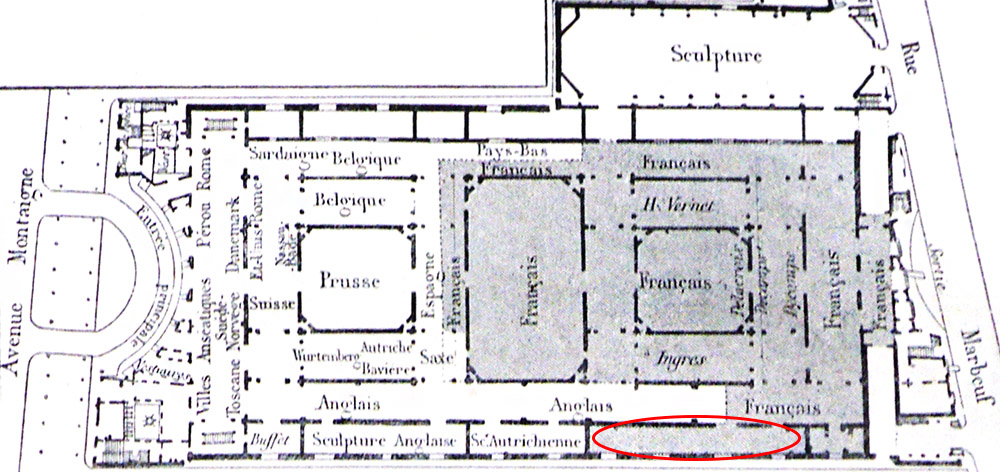
Although he considered it a nameless thing, Gorges’s review does identify its location at the Salon: Galerie 17, the galerie sombre.
The lateral wings of the Palais des Beaux-Arts housed overflow galleries for works that could not be accommodated in the principal rooms, as well as storage areas for rejected paintings.
Artists referred to these spaces as chambres mortes (“chambers of the dead”). The galerie sombre, in the right-hand wing, extended from two rooms containing Austrian and Italian sculpture. Lacking a skylight, it relied on dim light from high windows on one side, creating a perpetual twilight.
Paintings were therefore hung only on the wall opposite the windows. For a large canvas such as Une Soirée, perhaps due to a late entry, no other space was available. Several paintings by Courbet — whose Realist works invariably faced opposition from the jury — as well as works by Henri Scheffer (brother of Ary) and Auguste Delacroix (brother of Eugène) suffered the same fate.
Unlike these press reviews, none of the many jury-members mentioned anything about Une Soirée, except for de Musset73 who complained about his depiction by Biard in a short poem. Surprisingly, even count de Viel-Castel43, known for his caustic remarks on anyone and anything, did not mention it in his Memoirs. Only Chennevières20 (who wasn't a jury member) mentioned the painting in his Souvenirs in 1883.
After its bruising reception at the Exposition, Une Soirée began a long and unexpected journey — one that would carry it into obscurity, exile, and eventual rediscovery.
>>> Part Five: Descent into oblivion / Awakening of the Sleeping Beauty