The History of Une Soirée au Louvre
Click images above to access other main pages. Click Une Soirée or outside this page for the interactive image.
Part Five: Descent into oblivion / Awakening of the Sleeping Beauty
The devastating reviews of 1855 must have come as a shock to de Nieuwerkerke16. They confirmed what he likely already suspected: Francois Biard36 was no Francois Heim28b, and Une Soirée was far from the monumental homage he had envisioned.
In retrospect, he might have fared better with Paul Delaroche (who, surprisingly, does not appear in the painting), Léon Cogniet, or Hippolyte Flandrin79. Charles Giraud47, Eugène’s brother, had produced striking portraits and salon scenes, and de Nieuwerkerke later commissioned him to create a painting of his office at the Louvre.
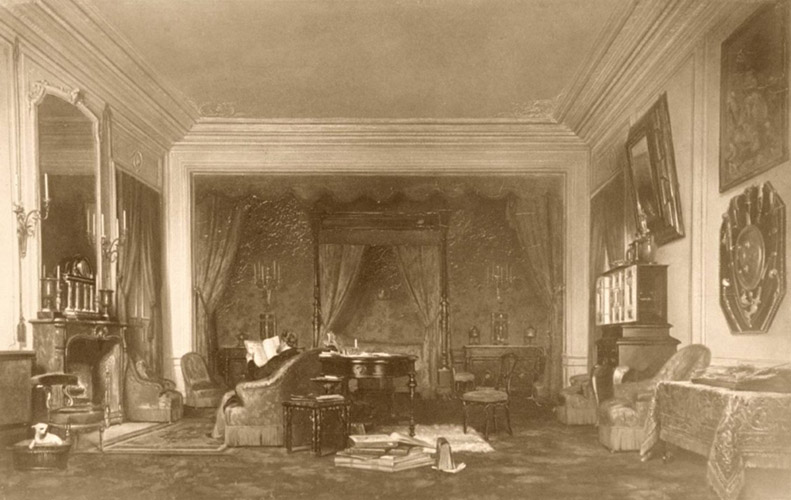
The public life of Une Soirée ended abruptly on 31 October 1855, the final day of the Salon. De Nieuwerkerke did not install it in an imperial residence or in the public galleries of the Louvre. He omitted it even from his 1863 report listing all artworks acquired since 1849. Instead, the painting was relegated to his private apartments, hung in a small Louis-XVI-style salon accessible only to his closest acquaintances.
From that moment, the painting began its long descent into obscurity. Many of the elite figures portrayed in unflattering fashion must have been relieved. For the next one hundred twenty-five years, the work effectively vanished from public memory.
Adolphe Braun photograph
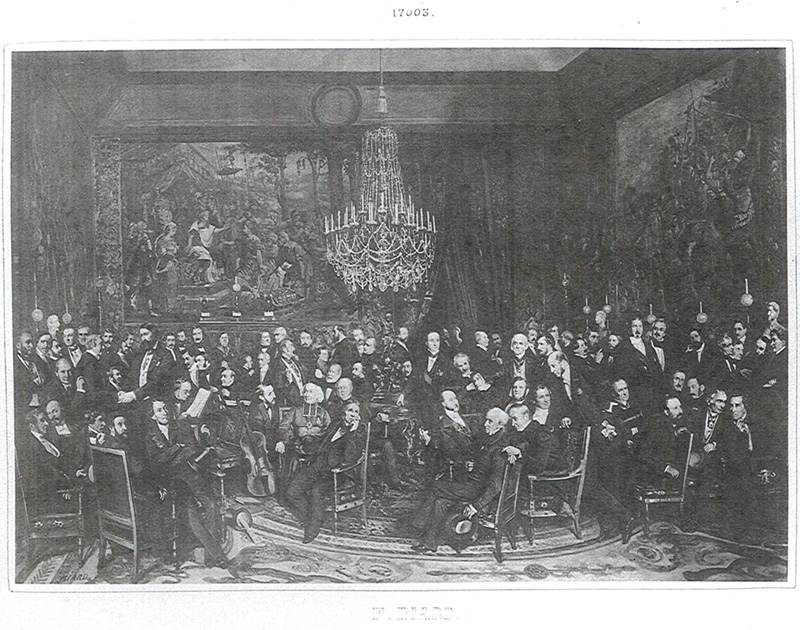
(Courtesy of the Musée d’Orsay photographic archives)
A reproduction of Une Soirée was produced by the Adolphe Braun company for its art publications. Braun had begun reproducing artworks in the late 1860s. The piece appeared in their 1880 catalogue under the title “Gathering of distinguished persons” (priced at 15 francs) and was listed among “Paintings in Private Collection.” Unlike most privately owned works in the catalogue, no owner was identified.
Because the title is so generic, it is unlikely that the reproduction was made while de Nieuwerkerke was still in Paris or that it was produced in his apartment. It must have been created after he resigned in September 1870. It also seems not to have been photographed at the Louvre galleries, since in that case it would have appeared in the catalogue’s Louvre section. De Nieuwerkerke’s successors were, respectively, Villot72 (up to 1874), Reiset65 (up to 1879), and Barbet de Jouy44b (up to 1881), so the reproduction could have been done under any of these directors. Nevertheless, the photograph eventually entered the Louvre’s photo collection, and conservator Grandjean is known to have had a copy on his desk in the late 1970s. This print of the image was kindly retrieved by the photographic archives of the Musée d'Orsay.
The end of the Second Empire
The collapse of the Second Empire in 1870, following the Franco-Prussian War, abruptly ended de Nieuwerkerke’s long administrative career. He resigned, left France, and settled in Lucca, a small Italian principality ruled by a young Bourbon prince known for his indulgent lifestyle. It also ended his twenty-year liaison with princess Mathilde Bonaparte, who moved in exile to Belgium.
Une Soirée, however, did not accompany him. As part of the furnishings and artworks acquired by the imperial household, it remained in France, classified within the Liste civile of Napoleon III (The Liste civile was documented by Catherine Granger in 2005).
During the liquidation of the Liste civile after the death of the Prince Imperial in 1879, a tribunal, under pressure from Empress Eugénie, ruled in 1880 that the Salon du Comte de Nieuwerkerke, still held in deposit at the Louvre, belonged to the private domain of the imperial family. Given that the painting had been purchased with public funds from the 240,000-franc state allocation (de Nieuwerkerke himself signed the sale), this ruling can only have applied to the usufruct – the legal right to use and enjoy something that belongs to another, not the ownership. The decision allowed the imperial family to place certain works in their residences, but the objects remained state property.
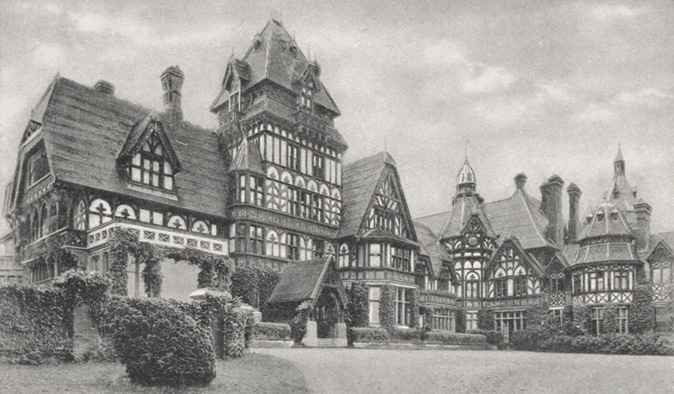
In 1881, these rights passed to Empress Eugénie, then living in exile in England at Camden Place, Chislehurst, before moving to Farnborough Hill. Based on the accounts of historians Frédéric Masson (e.g. known for his book Napoléon et les femmes (1894)) and Armand Dayot, and in the absence of any Farnborough inventory listing the painting, Une Soirée appears to have remained in storage in France, likely in the Louvre’s reserve collections.
In Souvenirs d’un directeur des Beaux-Arts (1883), conservator Chennevières20 lamented:
“This painting embodies a defining moment in the history of the Louvre […] and it is a great pity that the superintendent was not allowed to bequeath them to the Louvre, where they should have remained the traditional ornament of his successors’ cabinets. Let us hope at least that the marvelous series of portfolios containing the drawings of Eugène Giraud will later return to our museum: I am referring to those watercolor portraits, semi-caricatures, of the people who frequented the soirées of Monsieur de Nieuwerkerke.”
In fact, the purchase agreement shows that Une Soirée belonged to the state. Yet, as Catherine Granger notes, Louvre curators often followed their own criteria of importance. Barbet de Jouy, who appears in the painting, may even have preferred that it remained outside public view.
In 1896, Princess Mathilde acquired them and later bequeathed them to the French state’s print collection. If Giraud had been paid by de Nieuwerkerke personally, this transfer was legitimate. If he had been paid from the Emperor’s private funds, Mathilde could have claimed ownership. If, however, the caricatures had been financed by the state’s art-encouragement fund (as Une Soirée was), their private transfer would have been irregular.
In any case, Mathilde’s donation ensured their entry into the BnF, who occasionally makes them available for exhibitions.
The search for Une Soirée
In 1891, a researcher of Alfred de Musset73 published a query in L’Intermédiaire des chercheurs et curieux concerning a short poem Musset wrote in 1855, containing the line: “[Biard] rendered me awake, but also half.” The writer sought the painting’s whereabouts. The question remained unanswered until 1926, when another reader asked about the “Salon of Count de Nieuwerkerke” mentioned by Edmond About in his 1855 Salon review. A correspondent replied that they even had approached Marie Biard — daughter of Biard and Léonie d’Aunet — but that she could provide no information.
Toward the end of the century, historians Masson and Dayot, assisted by Eugénie’s representative Firmin Rainbeaux, traced the usufruct to the exiled Empress in England. For his monumental study of the Second Empire (published in 1900), Dayot arranged for an engraving to be made from the painting in the Louvre reserves — a rare moment when the work briefly resurfaced (see the references page for details on Dayot's efforts).
Dayot titled it Une Soirée au Louvre chez le comte de Nieuwerkerke and attempted to identify several figures, adding their names beneath the engraving in a sans-serif typeface fashionable at the time. In 1981, Louvre conservator Nicole Villa noted: “ce n’est pas une vraie grille,” meaning that these identifications had not been systematically verified (which is what my research intends).
Transfers to heirs and return to France
After 1900, the French state began a large-scale reorganization of imperial artworks belonging to the Liste civile. The Bonaparte family negotiated to recover certain objects under custodial rights (not ownership). This is how works ended up in Bonaparte residences such as Prangins Castle, Schloss Arenenberg, and Farnborough Hill.
In 1920, Paul-André Lemoisne reported in the Bulletin de la Société de l’Histoire de l’Art Français that Une Soirée had reached the Farnborough Hill estate.
After Eugénie’s death in 1920, her properties passed to Prince Victor Napoléon (Plon-Plon’s son). By 1926, researchers still had no clear information about the painting that had de Musset’s image. Upon Victor’s death in 1926, his possessions transferred to his son, Prince Louis Napoléon, though his mother, Princess Clémentine of Belgium, managed the estate until her son came of age in 1935. With strained finances, high maintenance costs at Farnborough, and no personal attachment to the property, she sold most of the collection except items of dynastic significance and works belonging to the French state. Thus Une Soirée returned to storage in France.
Return to the State and the painting’s modern fate
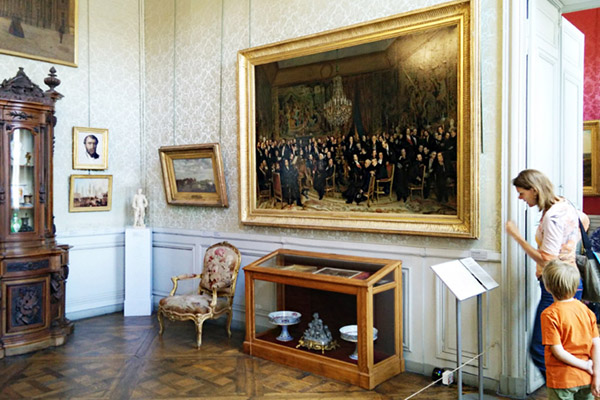
This context aligns with Nicole Villa’s 1981 observation that the Prince Napoléon Foundation placed Une Soirée on deposit at the Château de Compiègne in 1968 and later “donated” the painting to the State.
Legally, such a donation implied renouncing the usufruct, thereby restoring it to full and unequivocal state ownership.
In this respect, Chennevières’ wish for Une Soirée has finally been fulfilled. The French State has the option to present it to the public e.g. at Napoleon III’s château in Compiègne, in the imperial or ministerial rooms of the Louvre, among the many Second Empire objects at the Musée d’Orsay, or even alongside Eugène Giraud’s watercolor caricatures at the BnF.
Biard vs. Hugo: 175 years later, history has the last word
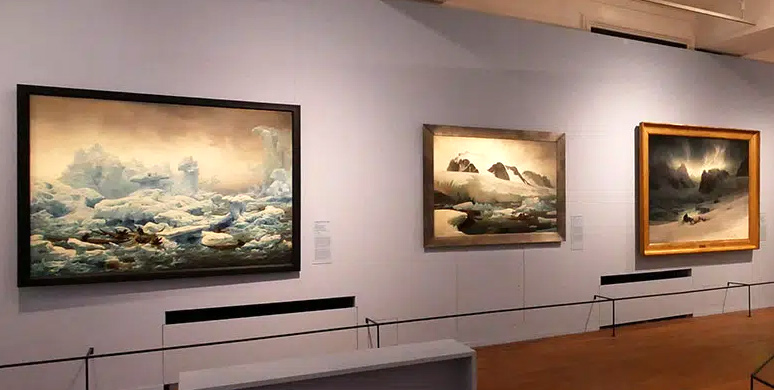
(2020/2021, not realized)
Biard36, explorer, traveler, humorist, and largely self-taught painter, achieved little posthumous recognition.
History sometimes plays tricks that fiction wouldn't dare.
The first major Parisian exhibition dedicated to Biard was installed in November 2020... at the Maison Victor Hugo —the very home of the man he had once caught in the act with his wife, and who helped raise his daughter.
Then, as if history itself couldn't resist adding one last twist, France decreed a national COVID-19 lockdown on October 29, 2020, with museums and cultural venues remaining closed well beyond the lockdown's end. The doors closed before they even opened, and the exhibition was dismantled in early April 2021 without a soul having seen it.
Present location and final thoughts
At present, Une Soirée is housed at the Musée du Second Empire in the Château de Compiègne. It hangs on a lateral wall, protected by a laser security barrier that prevents close viewing. The gallery is only accessible on Wednesday, Thursday, Saturday, and Sunday mornings between 10:00 and 12:00 (last admission at 11:30).
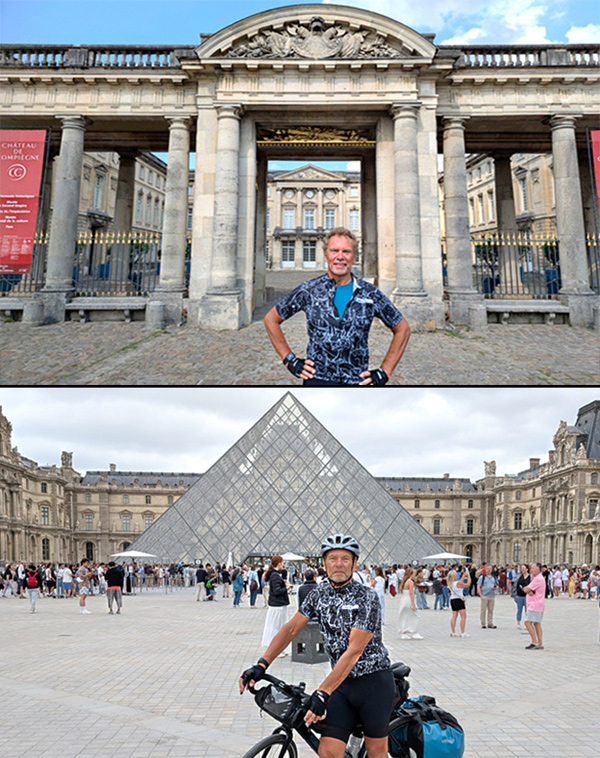
My hope is that this research — documenting this unique representation of the Louvre’s institutional history, its artistic networks, and the aristocratic milieu of the Second Empire — will help return the painting to the prominence it deserves.
After one hundred twenty-five years out of public view, and several transports, this “Sleeping Beauty” has suffered visible damage. One may hope that restoration will soon be possible, along with technical analysis of the canvas to reveal the revisions made in 1854.
Beyond the pleasure of reconstructing this remarkable chapter of cultural history, the purpose of this website is to offer visitors an in depth, interactive perspective on the social world of the early Second Empire — and, more broadly, to celebrate the extraordinary richness of French cultural heritage, accessible here even outside the constraints of visiting hours.