The History of Une Soirée au Louvre
Click images above to access other main pages. Click Une Soirée or outside this page for the interactive image.
Part Three: The 1854 revision
As discussed in my profile of Rachel Félix81, shifting attitudes toward the tragedienne, both in public opinion and within imperial circles, ultimately led to the decision to remove her from the composition. Press reports from May 1854, first published by the painter and writer Amédée de Taverne (1816–1871), owner of the Petit Courrier des Dames, reveal that Biard36 was not even halfway through depicting the assembled guests when he was instructed to revise the painting.
The 1854 article contains several noteworthy observations:
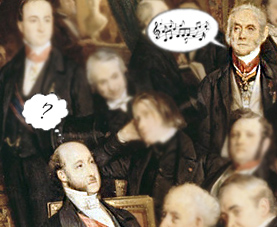
• “M. de Morny is listening to M. Auber.”
In the final canvas, de Morny48 and Auber56 are separated by at least two meters, with Regnault and Doucet between them.
Auber is not speaking at all. In fact, very few figures appear to be conversing; most gaze into the distance.
• “M. Horace Vernet is introducing Lieutenant Gérard, the famous lion-hunter, to Baron Desnoyers.”
In the completed version, Vernet31 introduces Gérard32 to Adrien de Longpérier37, although Desnoyers35 remains nearby.
• “The venerable M. Isabey, senior, is conversing with M. Mérimée and President Baroche.” In the final painting, Isabey52, Mérimée54 and Baroche61 are indeed positioned near one another, but they neither face each other nor appear to be engaged in conversation.
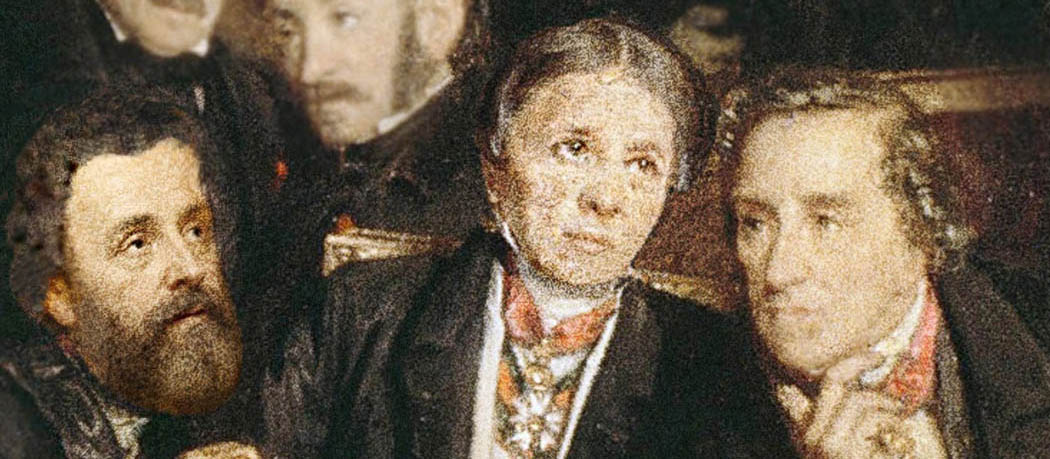
(artist impression)
• “… further on, Messrs. Ingres, Flandrin, and Meyerbeer are engaged in a discussion which Marshal Magnan is following with interest.”
In the final painting, Ingres39 stands halfway across the salon from the others; Flandrin79 converses with Eugène Isabey75, Régnier77, and Samson80 on the far right side; Meyerbeer76 speaks with Scribe74; and Magnan67 is placed several meters away, engaged with conservator de Saulcy69.
• “M. Fould is responding with his customary affability to some of the artists around him.”
In the final version, the only artist within Fould’s17 immediate vicinity is Delacroix10, seated behind him.
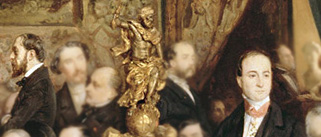
• “M. Fortoul is conversing with some archaeologists.”
In the completed painting, Fortoul46 speaks to no one, and the nearest (and only) archaeologist — conservator de Longpérier37 — is positioned on the opposite side of the monumental table and central statue.
• “Originally, the artist had imagined the moment when Mlle Rachel would recite some verses. That initial arrangement has been changed. The famous tragedienne will not be depicted in the painting.”
This aspect is discussed in detail in Rachel’s81 profile.
It is inconceivable that de Taverne, himself a painter, would have misidentified Ingres and others like Flandrin. A more plausible explanation is that Biard, compelled to revise the composition after Rachel’s removal, altered the placement of several figures. Because all male sitters were depicted in nearly identical evening dress, last-minute facial substitutions were feasible, provided that the insignia of the Légion d’Honneur remained accurate.
Two feasible scenarios:
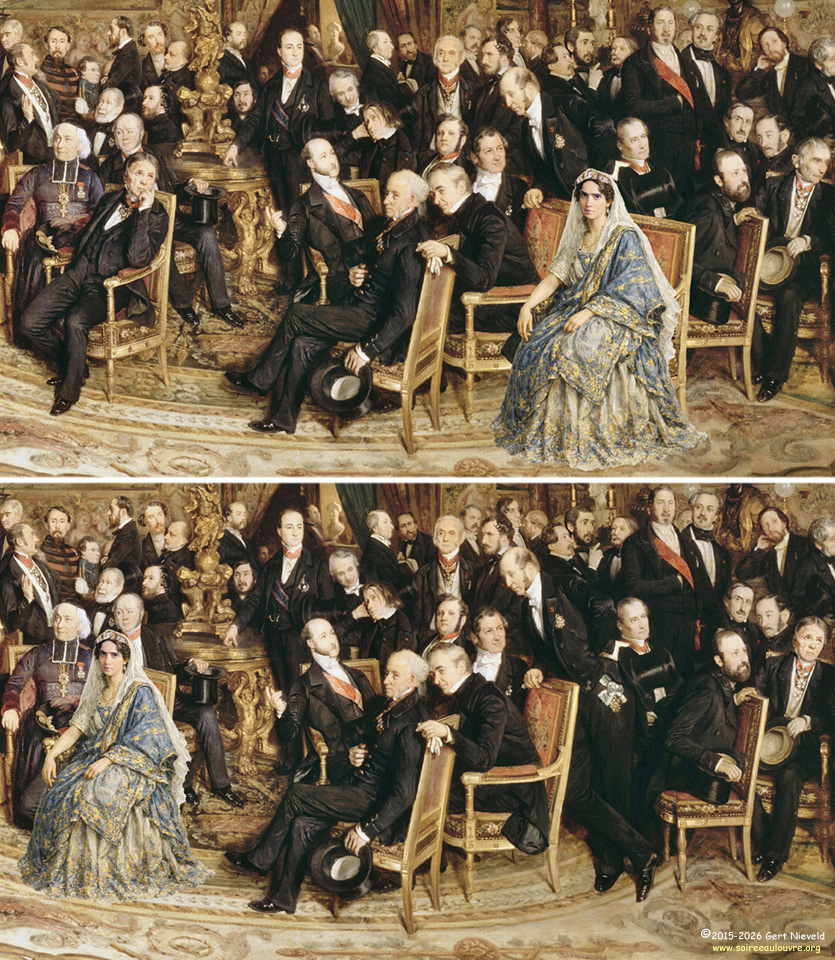
(artist impression - click to enlarge)
- If Rachel had originally been planned on the right side of the painting, in the “actors and dramatists” corner, close to her friends Ponsard70a, de Musset73 and her tutor Samson80, Biard only would have needed to adjust Baroche’s position to compensate for the removal of her figure and chair.
- If Rachel had been intended for a central position, Ingres may have been moved from the right side to Rachel’s position and replaced by Scribe74. Both men wore the insignia of Commanders of the Légion d’Honneur, making such a substitution visually plausible. This scenario aligns more closely with de Taverne’s description.
Above scenarios and images are artist impressions based on de Taverner's information. Only infrared reflectography, X-ray imaging, or comparable technical analyses could confirm these hypotheses.
The May 1854 article mentions approximately thirty individuals. Biard had less than a year to add another fifty, many of whom still needed to visit his studio to pose. De Taverne concluded his article optimistically:
“The arrangement of this scene is most successful, and we have no doubt that, once completed, the painting will be one of the most curious and most interesting works of the 1855 exhibition.”
One year and one major revision later, the painting was indeed “curious,” though far from successful.
Last-minute updates
By February 1855, time was running short, prompting Biard to write urgently to de Nieuwerkerke:
“Paris, February 14. Sir, this time, I must definitely finish my painting if I want to be ready for the time of the exhibition. Please be kind enough to give me the session I need, but let me know so that I do not go out at that time.”
The phrase “this time” (pour cette fois) implies that earlier attempts to secure a sitting had failed or been postponed, and that the situation had become pressing.
Biard added, with notable bluntness:
“Please also write a little note to Horace Vernet, because I must either give up or he must decide to give me an hour.”
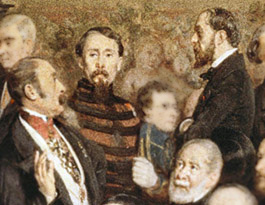
If Biard wanted Horace Vernet to introduce the "lion-killer" to de Longpérier rather than to Desnoyers, he may have needed this hour to complete Vernet’s likeness or to reposition him so that he faced de Longpérier rather than Desnoyers — a more logical pairing given de Longpérier’s involvement with African collections.
In either case, the letter confirms that Biard was still reworking the grouping in early 1855 and that he was prepared to replace Vernet if necessary.
De Nieuwerkerke did respond to the letter confirming a time to pose at Biard's atelier, and to also involve Vernet.
Did all de Nieuwerkerke's favorites make it to the canvas?
The February letter makes clear that the composition remained fluid only weeks before the Salon deadline, and that de Nieuwerkerke acted as the final arbiter of the arrangement. Given the extensive list of potential sitters, it is likely that some guests never made it onto the canvas and were either omitted or replaced. This may explain discrepancies between the final painting and the names mentioned in the Gazette du Midi and Courrier de l’Aude.
Notably, several prominent habitués of the vendredi-soirées — including de Nieuwerkerke’s close friends Arsène Houssaye, the painter and photographer Maxime Du Camp, the collector Lord Hertford (Marquess Seymour-Conway), and the banker Émile Pereire — appear in Giraud’s caricatures and attended the après-soirées, yet do not appear in Une Soirée.
Such last-minute alterations inevitably compromised the painting’s coherence. The removal of Rachel introduced structural imbalances, and Biard’s revisions produced several inconsistencies.
Inconsistencies
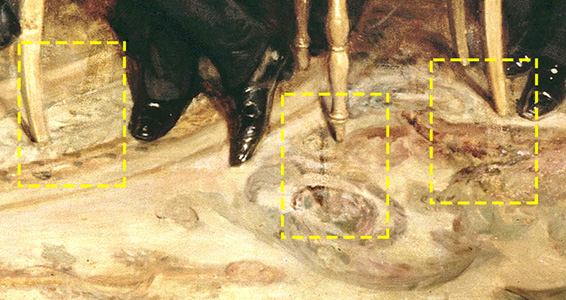
The chairs of Ponsard, Scribe, and Meyerbeer appear to have been shifted upwards and/or moved sideways.
Biard only partially managed to remove them, and neglected to adjust the carpet pattern accordingly.
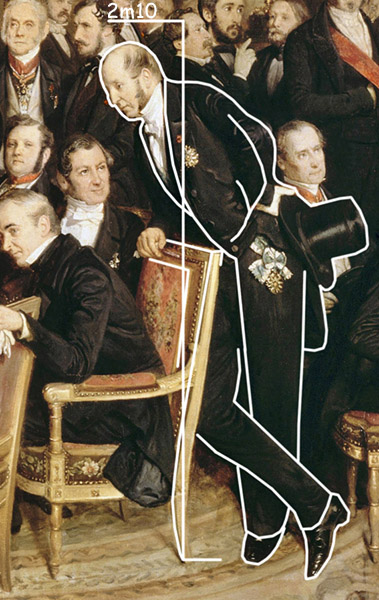
Baroche61 himself is depicted at an unnatural height. He stands on his left leg behind the left leg of Mérimée’s chair, with his right leg crossed in front, while leaning with his right arm on the opposite side of the chair.
This posture is anatomically impossible.
Be careful if you plan to try this position for yourself.
Baroche was a tall man, but when his height here is compared with the chair and with other men, he appears to stand well over two meters tall: a giant.
These inconsistencies demonstrate that Biard made substantial revisions in 1854 and highlight the limitations of a largely self-taught painter attempting a complex, multi-figure, composition requiring precise anatomical and spatial accuracy.
These revisions set the stage for the painting’s public debut at the 1855 Universal Exposition, a moment that would prove both spectacular and disastrous.
>>> Part Four: The Universal Exposition of 1855